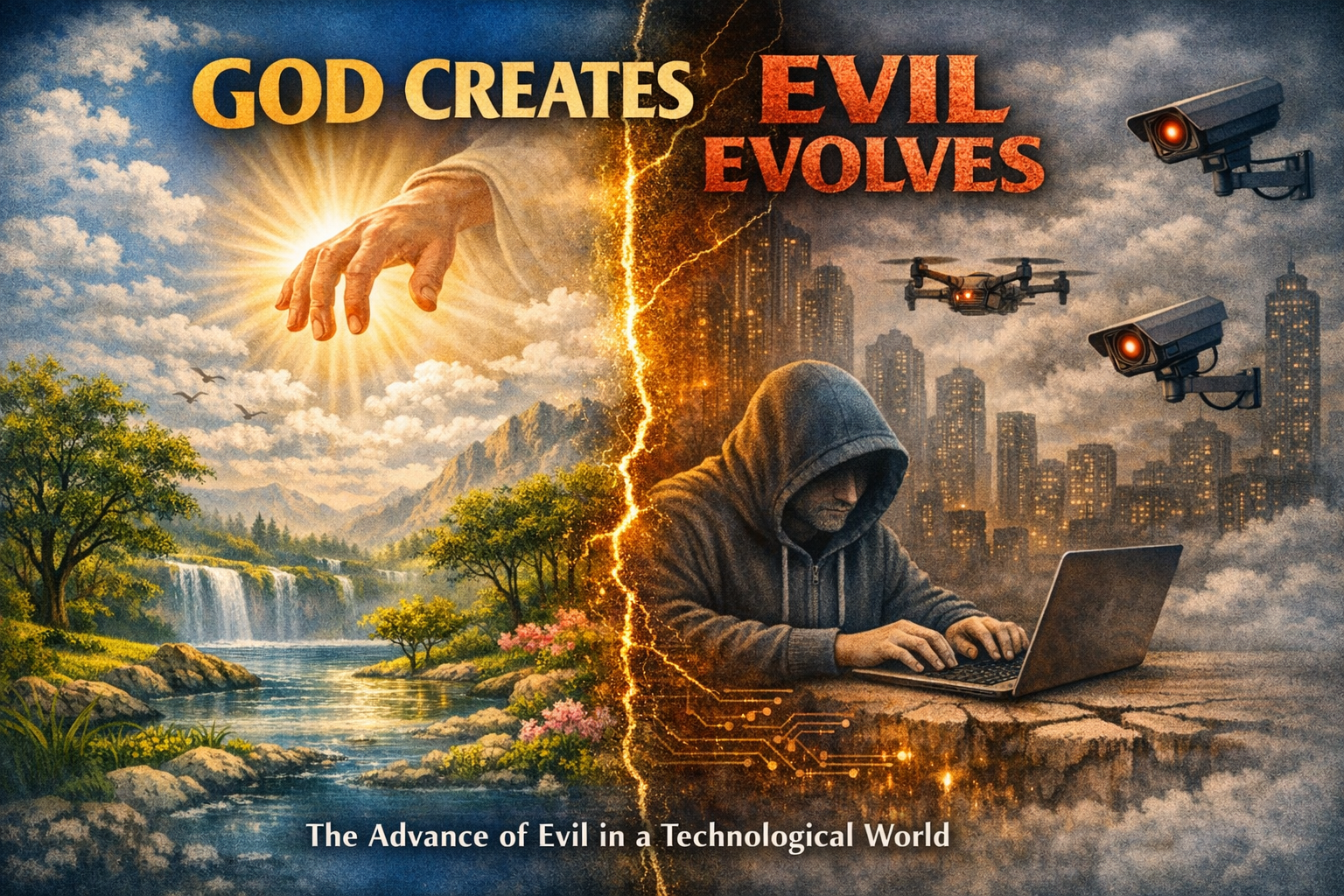
When I first encountered this four‑word truism, I didn’t think much of it. Still, it lingered. Something in the pairing of those words felt weighty—two realities standing as polar opposites. God creates; evil evolves. I set it aside for a time, as I often do with ideas that need to ripen.
Later, during my daily Bible reading, the phrase returned with force. Not only is it true, but it also serves as a key to understanding what unfolds across the entire biblical narrative—and what continues to unfold in our world. God creates, and what He creates is good. Yet evil enters, and once it enters, it does not remain static. It grows. It mutates. It evolves.
Let’s look first at the creative side of this truism.
“In the beginning God created the heavens and the earth.”[2] With each act of creation, Scripture repeats the refrain: “And God saw that it was good.”[3] The pattern culminates in the declaration, “Indeed, it was very good.”[4]
Creation begins in goodness, wholeness, and order.
Then comes the opposing force: the entrance—and evolution—of evil, beginning with the fall of Adam and Eve.
“Now the serpent was more cunning than any beast of the field which the LORD God had made.”[5] His opening question to Eve—“Has God indeed said…?”—is not an outright denial but a subtle distortion. Evil rarely begins with a shout; it begins with a whisper. A small twist of truth leads to desire, desire to disobedience, and disobedience to the entrance of sin into the world. Through that single door, corruption spread to the entire creation, for the spiritual core of humanity was now infected.
God, however, remains who He has always been. Even after the fall, God is still God. The same cannot be said for man. Something in humanity has shifted, and it’s downward.
The rapid escalation of evil becomes evident almost immediately. In the very next chapter, two brothers—Cain and Abel—bring offerings to the Lord. Abel’s is accepted; Cain’s is not. Cain’s reaction is telling: “Cain was very angry, and his countenance fell.”[6] God graciously warns him, offering both a path to restoration and a sober caution: “If you do well, will you not be accepted? And if you do not do well, sin lies at the door. And its desire is for you, but you should rule over it.”[7]
Cain refuses the warning. He “Talked” with Abel, meaning he led him into the field by deception and murdered him. In a single generation, evil has evolved from a simple act of disobedience to premeditated murder. The pattern is unmistakable: sin grows, spreads, and intensifies. And we can see this same escalation today.
The evil of sin is a cancer that attacks, distorts, and ultimately destroys everything it touches. When cancer invades a healthy cell, it alters the cell’s structure, leaving it unable to defend itself. So it is with sin. It infiltrates and reshapes every life it infects, leaving us helpless against its invasive power. And because sin is hereditary—passed from Adam to every generation—there is no vaccine to prevent it and no cure we can administer. Sin cannot be ignored, nor can it be controlled. It must be confronted as an enemy.
When we attempt to manage sin, it simply adapts. It evolves, sidestepping our efforts, shifting its form, and returning stronger than before. So what do we do? God’s warning to Cain gives us the answer. First, He reveals sin’s intention: “Its desire is for you.” Sin does not seek coexistence; it seeks domination, then destruction.
Then God gives the command: “You should rule over it.” How? By refusing to open the door. “Sin lies at the door”—crouching like a predator, waiting for the slightest crack. Once the door is opened, evil evolves so rapidly that we lose control and become controlled. That is exactly what happened to Cain. He opened the door, and sin escalated from resentment to rage to premeditated murder.
But there is hope. God has given us a companion—the Holy Spirit—to guide, convict, and empower us to resist sin in whatever form it takes. And He has given us His written Word, our light, exposing what is right and profitable and what is wrong and destructive. Recognizing the strength of sin becomes the beginning of our strength, because it drives us to the One who can overcome it.
Have you ever noticed that after the first transgression, the next one becomes easier? It’s because the person who committed the first sin is no longer the same person. Sin reshapes the heart, and the reshaped heart commits the next sin with less resistance. And so it continues, step by step, until Scripture records this tragic verdict: “Then the LORD saw that the wickedness of man was great in the earth, and that every intent of the thoughts of his heart was only evil continually.”[8] What a heartbreaking account. Humanity, created in the image of God, had descended to a place where every thought and intention was bent toward evil.
Jesus echoes the ancient pattern with a warning about the residence of evil: “You have heard that it was said to those of old, ‘You shall not commit adultery.’ But I say to you that whosoever looks at a woman to lust for her has already committed adultery with her in his heart.”[9] Intent—evil hidden in the secret chambers of the heart—is already destructive. What begins as an inward desire soon becomes an outward action. The seed is planted long before the fruit appears.
Intent quickly advances to violence. “The earth also was corrupt before God, and the earth was filled with violence.”[10] Evil continues to evolve, and its goal comes into view: death. Not the death of one, but of all. In just two chapters of Genesis—from chapter 4 to chapter 6—we move from the murder of a single man to a world saturated with violence.
Yet God grants humanity a reprieve through Noah. Noah and his family have the opportunity for a new beginning. But this fresh start is short‑lived. One lesson stands above the rest: the Flood did not cure sin, nor did it destroy evil entirely. Noah and his family carried sin with them. Sin is metaphysical; it resides in the very being of man. We see its physical consequences, but its root is spiritual. Being hereditary, evil simply boarded the ark and stepped out onto dry ground with Noah.
After the Flood, humanity multiplied, and because they shared one language, evil spread rapidly. “And they said, ‘Come, let us build ourselves a city, and a tower whose top is in the heavens; let us make a name for ourselves, lest we be scattered abroad over the face of the whole earth.”[11]
Their tower was not merely a building—it was a declaration. “Build ourselves a city.” “Make a name for ourselves.” These are the words of a people convinced that unity and technological achievement have made God unnecessary. Their arrogance was their theology.
Is it much different today?
Have our scientific, medical, and technological advances drawn us closer to God, or have they convinced us that we no longer need Him? The world is shrinking. Distance and language no longer separate us. We are becoming one people again—connected, informed, and increasingly unified. But has this unity strengthened our faith, or are we standing on the threshold of another Tower of Babel?
I believe we are on that precipice. Technology is not the enemy; it has improved our lives in countless ways. But we must never forget that evil resides within us, and it adapts as quickly as our inventions do. Every advance becomes a new opportunity for corruption. Technology can serve us, but it can also blind us to spiritual realities and divide us socially and morally.
History shows how dramatically evil has evolved in its use of technology. We recoil at the brutality of ancient warfare, yet we seldom consider the destructive power of modern weaponry. Evil has taught us to sanitize war—clean screens, distant drones, clinical terminology—while the devastation is exponentially greater.
Many of our greatest technological breakthroughs were born from conflict. Nuclear energy emerged from the atomic bomb. The foundations of space travel were laid by the German V2 rockets that rained destruction on England. It is true that good technology has come from evil technology. Yet with nearly every technological advance, the evil within humanity has adapted, finding new ways to use our own creations against us.
Technology has also played a role in the erosion of the nuclear family. We are more connected than any generation before us, yet more isolated. We have allowed devices to replace dialogue, screens to replace shared meals, and entertainment to replace instruction. The result is a downward spiral: fractured families, children without guidance or discipline, rising poverty, declining education, increased crime, and a growing dependence on government support. And through it all, nearly everyone has a smartphone.
It is ancient Rome all over again—only with better technology.
Smartphones have become an addiction as powerful as drugs or alcohol. We now have young people who struggle to read or write proficiently, yet can navigate a smartphone with remarkable skill. How many lives have been lost because a driver stared at a screen instead of the road? The foolishness of risking your life—and the lives of others—should be obvious, yet it persists. Worse still, we have become numb to the danger. Our judgment is clouded by technological dependence.
Social media is another form of addiction. People are being shaped—emotionally, morally, and intellectually—by “influencers” they have never met. Many accept whatever they see online without the slightest investigation into its truthfulness. For countless individuals, the world of social media feels more real than real life. It dictates their emotions, their decisions, and their sense of worth. The irony is painful: social media is replacing our ability to socialize. How often do we see three or four people gathered around a table, not speaking to one another, but staring at their phones?
Who is serving whom? Has this technology drawn us closer to God, or has it become a playground for the evolution of evil? Has it strengthened the nuclear family or contributed to its collapse? And how is having a “god” in your hand any different from an idol carved from wood or stone? In truth, a device that demands your constant attention is far more seductive—and far more dangerous.
Advances in medical technology are not exempt from the evolution of evil. When new treatments emerge, they can be used either to restore life or to enable destructive behavior. Instead of seeing certain diseases as warnings that call us back to God’s design, many reject His Word and use medical breakthroughs as permission to continue down harmful paths. This includes behaviors Scripture identifies as sin, such as homosexuality. Likewise, surgical advances—intended to heal—are now used to mutilate healthy bodies in an attempt to redefine what God has already defined. These are harsh realities, but we are dealing with life and death. Sin must be exposed for what it is: destructive. Those caught in its grip must be told the truth with compassion and firmness, ensuring that our compassion does not become enabling.
Gluttony offers another example. Instead of curbing appetites, we now have medications that allow people to indulge without consequence—shots that counteract overeating so the cycle can continue. It echoes ancient Rome, where the elite would feast, purge, and feast again for hours. The tools have changed; the sin has not.
There is only one true alternative to dealing with evil: death. Not physical death, but the death of the old self. We must be born again. We must continually put the flesh in its place and walk in the new life Christ offers. In short, we must shut the door. Through the power of the Holy Spirit, God gives us the strength to resist evil and separate ourselves from it. As long as we inhabit these earthly bodies, we will be at war with the flesh, but as we grow in faith, resisting evil becomes increasingly possible.
The subtlety of evil would have us believe that God has changed—that He is no longer righteous, no longer just, and certainly no longer a God who judges. But this deception is as old as Eden. Will we believe God’s Word and accept Jesus Christ as the Son of God and our only hope of salvation, or will we allow evil to evolve until our minds are darkened against the truth? Physical death is certain for all, but the wages of sin are death both physically and spiritually.
Evil has so permeated the sciences that any reference to God or creation is taboo, yet the same community readily embraces the godless theory of evolution. Ironic, isn’t it? The evolution of evil has advanced so far that the theory of evolution—taught as fact—has replaced the reality of creation by God.
When the fullness of iniquity is reached—when the evolution of evil is complete—the time of grace will end, and judgment will follow. Evil and all it has infected will be destroyed. Until that day, remember this: technology can be good or bad, depending on two things—how it is used, and whether you are the user or the one being used.
From Eden to Babel, from ancient empires to the digital age, the pattern has never changed. God creates; evil evolves. What begins as a whisper becomes a worldview. What starts as a single act of disobedience becomes a culture of rebellion. And in every generation, evil adapts to whatever tools humanity fashions—whether stone, bronze, steel, or silicon.
Technology, medicine, science, and communication are not evil in themselves. They are gifts of God’s common grace. But because evil resides within the human heart, it grows alongside our inventions, learning to use them as instruments of distraction, deception, and destruction. The question is not whether technology is good or bad, but whether we will use it for righteousness or allow it to use us for ruin.
Scripture warns that evil will continue to grow until the fullness of iniquity is complete. When that day arrives, the window of grace will close and judgment will follow. Yet God has not left us without hope. The only cure for sin is the death of the old self and the birth of a new life in Christ, empowered daily by the Holy Spirit to resist evil’s subtle pull.
The lie whispered to Eve still echoes today—that God has changed, that His Word is outdated, that His standards no longer apply. But God has not changed. His righteousness, His justice, and His call to repentance remain the same. The question is whether we will believe His Word or allow evil to shape our hearts into darkness.
We live in a world overflowing with knowledge yet starving for truth; connected by technology yet divided in spirit; celebrating progress while ignoring the ancient warning that “the wages of sin is death.”[12] But for those who turn to Christ, there is life—new, eternal, victorious life.
Evil will reach its appointed end. Judgment will come. Until then, we must walk wisely, discerning whether we are using technology or being used by it. For the evolution of evil is relentless—but so is the grace of God for all who call upon His name.
[1] All Scripture quotes are from the NKJV unless otherwise noted
[2] Gen. 1:1
[3] Ge. 1:10
[4] Gen. 1:31
[5] Gen. 3:1
[6] Gen. 4:5
[7] Gen. 4:7
[8] Gen. 6:5
[9] Math. 5:27-28
[10] Gen. 6:11
[11] Gen. 11:4
[12] Romans 6:23
Last Updated on March 19, 2026 by admin