While attending a class on signs of the end times, the instructor linked one of those signs to Nebuchadnezzar’s dream in Daniel, and I was inspired by something in the dream and its meaning that the lecture did not cover. It was the last portion of the dream that scared Nebuchadnezzar, though he could not recall it.
The Bible tells us that God revealed to Daniel the dream that the king could not remember and gave him its interpretation. As Daniel begins to tell the king about the dream, he makes two critical points. First,” But there is a God in heaven who reveals secrets,” and, secondly, the dream is a prophecy, “He has made known to King Nebuchadnezzar what will be in the latter days.” [2]
Daniel’s statement gives us two additional insights. One: the vision Nebuchadnezzar saw concerns the latter days, not the last days, or end times. Secondly, the prophecy begins, not in the distant future, but with Nebuchadnezzar’s kingdom.
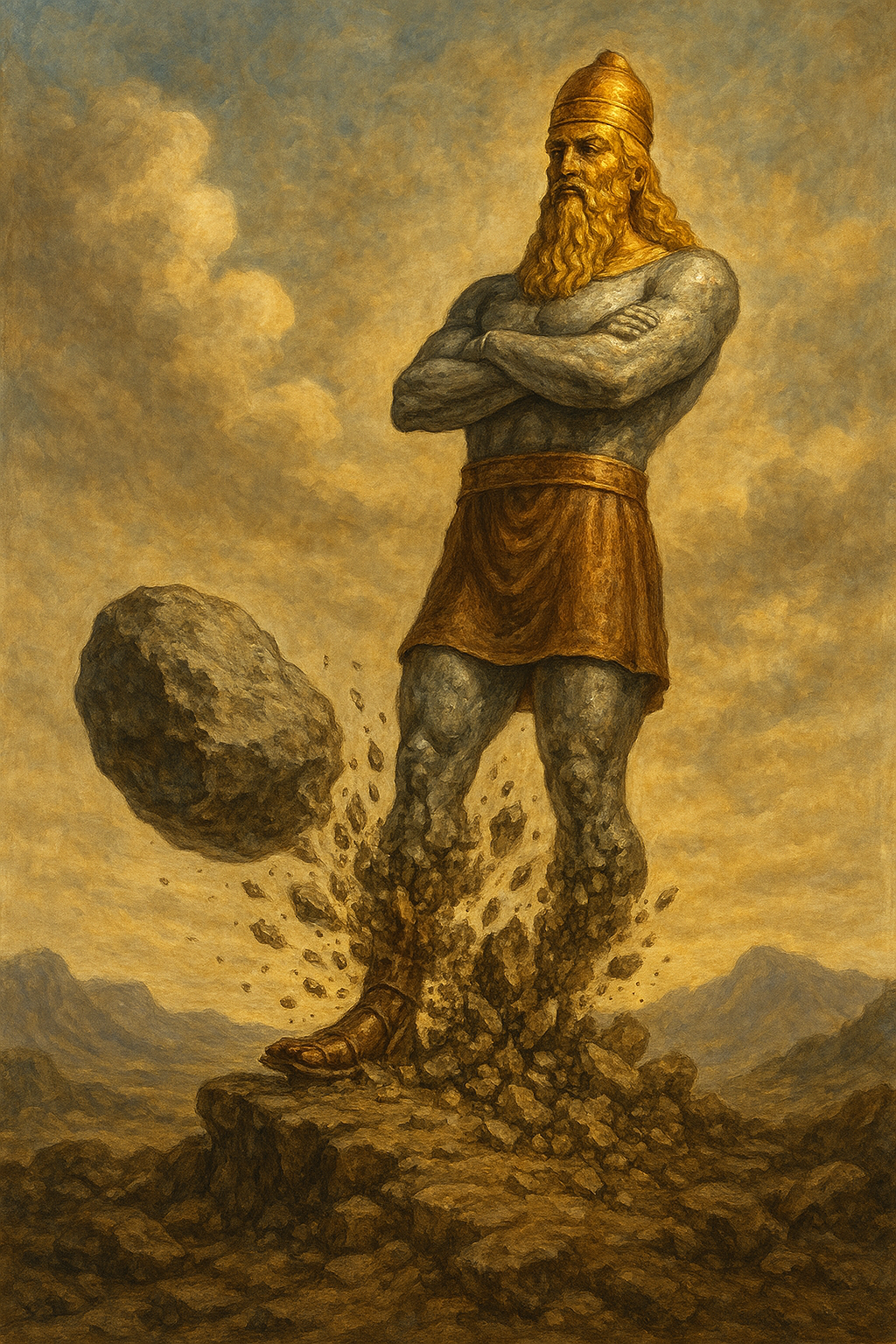
In the dream, he sees an image of a man. Daniel describes it as a “great image” with “excellent splendor” and an “awesome form.” [3] From top to bottom, the image has four sections, each made of a different metal: gold, silver, bronze, and iron. At the base of the image, there is an oddity detailed in the feet.
The Bible tells us that the four parts, composed of four metals, represent empires, and that the first empire, Babylon, is personified in its king, Nebuchadnezzar. “You are this head of gold.” [4]All the materials listed that comprise the image have different qualities, none of which relate to value. They tell us more about the purity and strength of the empires they represent than about their individual value.
The head of gold, Nebuchadnezzar’s kingdom, is the purest of the four materials; it does not tarnish or decay, but it can be destroyed. The singularity of purpose and unity of Babylon would be sought after by every empire that followed it, but never obtained it. The dream’s interpretation foretold that Babylon would be destroyed, a historical fact today.
The kingdom that followed Babylon was Persia, ruled by Cyrus the Great (539 BC), with the chest and arms of the image depicted in silver. Building on the theme of succession, the Bible tells us that this silver kingdom (Persia) is inferior to Nebuchadnezzar’s kingdom. Inferior, yet able to conquer it and rule longer. In their raw, or unalloyed form, silver is stronger than, yet not as pure as, gold, and it will tarnish over time. Babylon was the dominant nation over the known world from 636 to 539 BCE. In 539 BCE, Persia conquered Babylon and became the dominant empire until 330 BCE. The interim between the two was the Median kingdom, which is not separately represented in the image. Because the kingdom of the Medes and Persians shared vast similarities with Babylon, but was far less civilized, perhaps a tarnished version of the silver.
The belly and thighs of the image are unique in the empire it represents. Alexander the Great began his conquests with a battle against Persia in 334 BCE. In eight years, and only in six major engagements, he had conquered a territory that stretched from Italy to the Black Sea. From Egypt to India, before he died in 323 BCE. The true victor was the Grecian way of life, the Hellenistic culture, which outlived Alexander and held sway over his conquered territory for the next 260 years until the Roman Empire’s reign.
Rome adopted much of Greek culture, creating a Greco-Roman culture, demonstrating that cultural influence outlasts military power. Such cultural conquest was a battle won without weapons. General Gerald Templar put it this way: a battle “for the hearts and minds,” in effect challenging existing traditions and winning over the local populations, which Hellenism certainly did. There are two ways to accomplish this: by persuasion or temptation. The latter became the weapon of choice for the evil that seeks to destroy the kingdom of man. Long before Gerald Templar’s famous statement, Sun Tzu, in his book, The Art of War, said, “The supreme art of war is to subdue the enemy without fighting.” Throughout man’s history, temptation has conquered more lives than battle. It is still true today.
Bronze has no inherent purity, as it is an alloy of two or more metals, primarily copper and tin. It was particularly common during the Greek era. Bronze could be hard or soft, stiff or flexible, based on how it was cast. It was inexpensive and easy to shape into many valuable items. It could be fashioned into weapons, dishes, shields, or decorations. Stronger than gold or silver, yet it was the least pure of the three.
Advancing to the fourth kingdom, depicted as iron legs, we arrive at the Roman Empire. Rome became the dominant empire of the known world by 63 BC. The boundaries of Rome would stretch and almost cover the entire area ruled by the preceding kingdoms. Comparing metal to metal, the three previous kingdoms are no match for iron, in strength or destructive capability.
But this fourth kingdom had another feature: its feet and toes were a mixture of iron and baked clay, an odd composition exposing both its strength and its weakness. Rome conquered the territories ruled by the three previous empires. Though it destroyed their rulers, it retained the vices and virtues of those peoples, representing what we now call diversity.
The weakness of Rome lay in its physical, spiritual, and cultural impurity. To maintain control and peace, the conquered peoples’ differing religions were welcomed and yet tolerated. Rome’s brand of freedom of religion had only one firm rule: the gods and goddesses of Rome had to be equally worshiped and respected, ultimately culminating in the worship of the emperor as a god on earth.
While diversity of people and cultures can be a strength, it can also be a weakness; racial and cultural differences can easily become dividing points. These divisions, the various races and cultures, represented by the baked clay, can be controlled through the strength of iron, but can break apart at the toes and feet, causing the entire kingdom to fall. All that was needed was the proper force at the appropriate time to bring it all down, destroying the fourth empire and the preceding empires that comprised the image.
The truly unique point here is not the image itself or the four kingdoms it symbolizes, but what brought it down. A stone cut without hands struck the toes of Nebuchadnezzar’s image, causing it to fall, revealing a force beyond human comprehension as the agent of destruction.
This was the part of Nebuchadnezzar’s dream that frightened him the most, and he wanted to forget it. Nebuchadnezzar understood kings and kingdoms in terms of the conquests and defeats of warring armies. What he could not comprehend was that a stone would be able to destroy a kingdom. How could a stone destroy empires of metal? But this was not just any stone; it was one of supernatural origin.
The stone was cut for a specific purpose. It was cut, or hewn, not accidentally, but with intent. Someone or some unseen force made it, but who or what? Nebuchadnezzar knew how stones were quarried for building. But seeing a stone taken from a mountain, without any visible quarrying, must have terrified him. Seeing a stone made by an unseen force that could crush four empires was inexplicable. How can you defend yourself against such a power?
Nebuchadnezzar could not have misunderstood the object that struck the image’s feet as something resembling a stone. No, because the term “stone” in verse thirty-four is ‘eben, which is Chaldean, Nebuchadnezzar’s native tongue, for stone. There was no misunderstanding, no misinterpretation. It was a stone.
“And in the days of these kings the God of heaven will set up a kingdom which shall never be destroyed.” [5]Linking back to the image, that kingdom remains to this very day. How is it that the kingdom Daniel refers to will never be destroyed? Because “the kingdom shall not be left to other people.” The security of this kingdom will not rely on the strength of armies, nor on cunning political influences, but in the hands of the same power that hewed the stone out of the mountain and destroyed the image. The vision Nebuchadnezzar saw, and the destruction it foretold, have come to pass as historical fact.
The stone from God’s Mountain in the dream foretold of Jesus the Messiah. He was the stone that brought down the Roman Empire. Think of it, the stone rejected by the builders would bring down the Roman Empire. God cut this stone out of his own being, from his own mountain, as it were. Jesus, the cornerstone, the first stone of the foundation of a spiritual kingdom, the Kingdom of God. From that stone, a mountain would grow, until it filled the whole world.
Historians continue to wrestle with theories to pinpoint precisely what brought the Roman Empire down. Some say it was political, others say it was financial, and still others say it was a combination of reasons. But the real reason is revealed in the image. An empire held together by the strength of iron but lacking true unity was fragile. No matter how much people cooperate and work together to accomplish great things, they will never be truly one people. Separated by race, culture, and various traditions, each one tainted by the sin within, all of which reside in the hearts and minds of men, makes any man-made empire fragile.
Iron with more than 2% coke content becomes brittle. Iron ore is heated to specific temperatures to drive out the impurities. But the Iron that represented Rome was corrupt, its impurity making it brittle. And when struck with the right instrument, it would break apart.
Only God can join mankind in a unity that is not fragile. A unity which physical forces cannot conquer. A unity where sin no longer rules the hearts and minds of men. A kingdom not subject to the physical lusts of men seeking to rule over or take from one another. The more people try to accommodate everyone’s lustful whims, the more fragile people become. Where does it end? Eventually, everything is allowed, labeled under the banner of equality, where there can be no equality, as long as sin dwells in the hearts of men. In the end, it is ‘what is in it for me, and whatever I determine I need dictates what is right.’ This is what destroyed Rome, every kingdom that followed, and will follow.
This is why the image was struck, not repaired, supported, or corrected. It must be brought down and replaced with something entirely new. Build on the foundation of God’s design. A kingdom built on a rock, a spiritual kingdom on a spiritual rock, that is not subject to destruction by physical powers.
“Then the iron, the clay, the bronze, the silver, and the gold were crushed together, and became like chaff from the summer threshing floors; the wind carried them away so that no trace of them was found.”
Jesus reiterated Nebuchadnezzar’s dream, “Then He looked at them and said, ‘What then is this that is written: ‘The stone which the builders rejected Has become the chief cornerstone’? Whoever falls on that stone will be broken; but on whomever it falls, it will grind him to powder.” [6]
And what becomes of the stone that struck the image?
“And the stone that struck the image became a great mountain and filled the whole earth.” Out of the physical ruins of Rome, Christianity, the Church founded by Christ, emerged. A spiritual kingdom, unlimited by the physical, it grows into a great mountain and eventually fills the whole earth. It is a kingdom that can be favored, oppressed, or even persecuted, but cannot be destroyed.
Its members are found everywhere, in every Christian community, with no single denomination holding the principal place. No denomination can claim they are ‘the church,’ for the body of Christ is not determined by man-made boundaries, rituals, doctrines, or traditions. By the time Rome fell, Christianity had spread over the entire Roman Empire, the then-known world.
Nebuchadnezzar saw a dream containing an image he recognized, respected, and, in some sense, adored, destroyed by an object he feared because its origin and power defied explanation, logic, and every physical property he understood. That is what struck fear into the man who, at that time, had no equal.
It went even further. How could a stone grow? Into a mountain no less. All of this could only be the result of one thing – God, and His ability to determine the fate of nations. History verifies the rise and fall of the empires depicted in the image. The stone that became a mountain continues to this day, without a logical explanation save one—God himself. The folly of sinful man, seeking to build an empire in defiance of God, is a return to the tower of Babel.
All scripture quotes are from the New King James version unless otherwise noted
[2] Daniel 2:28
[3] Daniel 2:31
[4] Daniel 2:38
[5] Daniel 2:44
[6] Luke 20:17-18
Last Updated on January 7, 2026 by admin